

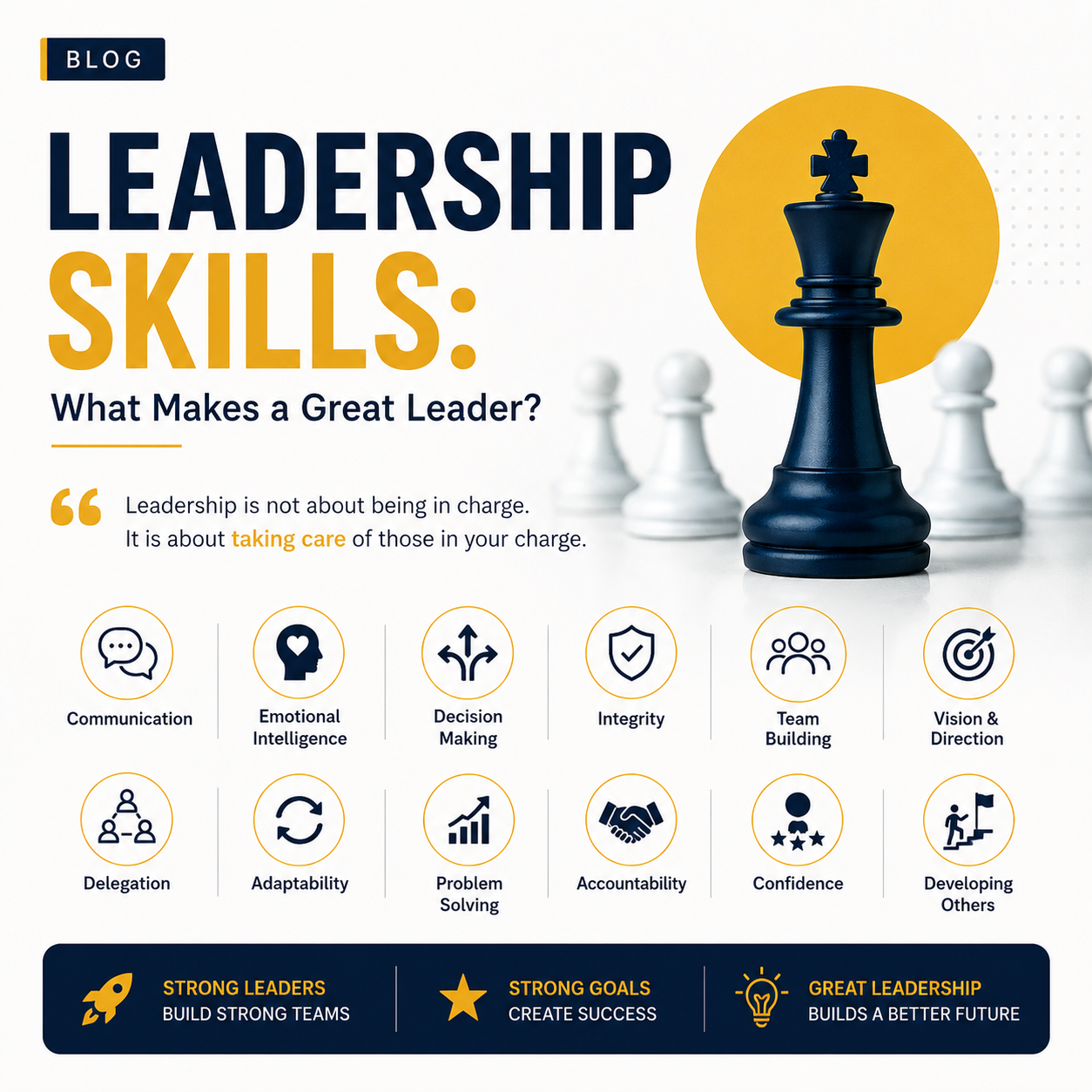
What comes to your mind when you hear the word leader?
A manager sitting in an office? A company CEO? Someone standing in front of a large team?
Leadership can certainly involve these roles—but being a leader is about much more than having a job title.
You can be a leader without being a manager, and you can be a manager without being a particularly good leader.
A great leader is someone who can inspire people, make thoughtful decisions, communicate clearly, take responsibility, and help others become better.
Whether you’re leading a business, managing a team, working on a project, or simply trying to advance your career, developing strong leadership skills can make a significant difference.
So, what actually makes a great leader?
Let’s explore the leadership skills that matter most.
What Is Leadership?
Leadership is the ability to guide, influence, support, and motivate people toward a shared goal.
It isn’t simply about telling people what to do.
A good leader creates direction, builds trust, solves problems, and helps people perform at their best.
Think about a sports team.
The captain doesn’t win the game alone. Their role is to help the team stay focused, encourage teammates, communicate during difficult moments, and lead by example.
The same principle applies in the workplace.
Leadership is about bringing people together to achieve something meaningful.
1. Communication
If there is one skill almost every great leader needs, it’s communication.
Leaders constantly communicate with employees, colleagues, customers, partners, and other stakeholders.
They need to explain goals, provide instructions, share ideas, give feedback, and sometimes deliver difficult news.
But effective leadership communication isn’t just about talking.
It’s also about listening.
A strong leader should be able to:
- Explain ideas clearly
- Listen to different opinions
- Ask meaningful questions
- Give constructive feedback
- Communicate expectations
- Handle difficult conversations
- Adapt communication to different people
When people understand where they are going and why it matters, they’re more likely to work toward the goal with confidence.
2. Emotional Intelligence
Great leaders understand that they’re working with people, not machines.
Employees have emotions, concerns, ambitions, frustrations, and personal challenges.
Emotional intelligence helps leaders understand and manage these human factors.
A leader with strong emotional intelligence can recognize when a team member is struggling and respond appropriately instead of immediately criticizing them.
Emotional intelligence includes:
- Self-awareness
- Self-control
- Empathy
- Social awareness
- Relationship management
This doesn’t mean a leader should avoid difficult conversations.
Instead, it means they know how to handle those conversations with maturity and respect.
3. Decision-Making
Leadership often means making decisions when there isn’t a perfect answer.
Should the company invest in a new project?
Should a deadline be changed?
Should a team member take responsibility for a new role?
Should an existing strategy be changed?
A great leader doesn’t necessarily make every decision perfectly.
Instead, they know how to:
- Gather relevant information.
- Consider different perspectives.
- Evaluate risks.
- Make a decision.
- Communicate it clearly.
- Take responsibility for the outcome.
Indecision can be just as damaging as a bad decision.
Good leaders know when they have enough information to move forward.
4. Accountability
One of the clearest differences between a good leader and a poor leader is how they handle mistakes.
A poor leader may immediately look for someone to blame.
A great leader asks:
“What can we learn from this, and what can we do differently next time?”
Accountability means taking responsibility for your decisions and actions.
If something goes wrong, a strong leader doesn’t simply point fingers.
They look at their own role in the situation and work with the team to find a solution.
This creates trust.
When employees know their leader will take responsibility, they are often more comfortable being honest about problems.
5. Vision and Direction
People need to know where they’re going.
A leader’s job isn’t just to manage today’s tasks. Good leaders also think about the future.
They create a clear vision and help their team understand how their work contributes to that vision.
For example, instead of telling employees:
“We need to increase sales.”
a leader might explain:
“Our goal is to become the most trusted service provider in our market, and improving customer experience is one of the most important steps toward getting there.”
The second message gives people something bigger to understand and work toward.
6. Team-Building
A leader is only as strong as the team around them.
Great leaders understand that different people bring different strengths.
One employee might be excellent at solving technical problems.
Another might be great at communicating with customers.
Someone else might naturally organize projects and keep everyone on track.
Good leadership means recognizing these strengths and creating opportunities for people to use them.
Strong team-building involves:
- Building trust
- Encouraging collaboration
- Recognizing contributions
- Resolving conflicts
- Creating shared goals
- Supporting professional growth
- Making people feel valued
A successful team isn’t simply a group of talented individuals.
It’s a group of people who work effectively together.
7. Delegation
Trying to do everything yourself may feel productive, but it isn’t sustainable leadership.
Great leaders know how to delegate.
Delegation doesn’t mean simply giving someone a task and walking away.
Effective delegation means giving the right person:
- A clear responsibility
- The necessary resources
- Appropriate authority
- A realistic deadline
- Clear expectations
Delegation also gives team members opportunities to develop their own skills.
A leader’s job isn’t to become the person who does everything. It’s to build a team capable of achieving more together.
8. Adaptability
The business world changes constantly.
Technology changes.
Customer expectations change.
Markets change.
Teams change.
A strategy that worked last year may not work today.
That’s why adaptability is an increasingly important leadership skill.
An adaptable leader doesn’t panic whenever circumstances change.
Instead, they assess the situation, learn what they can, and adjust their approach.
Ask yourself:
“What does this situation require from me as a leader?”
Sometimes the answer is to take charge.
Sometimes it’s to listen.
Sometimes it’s to change direction.
Sometimes it’s to give the team more freedom.
Leadership isn’t about using the same approach every time.
9. Confidence
People naturally look to leaders for direction, particularly during difficult situations.
This is where confidence matters.
But there’s an important difference between confidence and arrogance.
Confident leaders can say:
“I don’t have the answer yet, but I’ll find out.”
Arrogant leaders may pretend they know everything.
True confidence allows you to make decisions while remaining open to new information and other people’s ideas.
You can build leadership confidence by:
- Increasing your knowledge
- Preparing for important decisions
- Learning from experienced leaders
- Practicing communication
- Accepting constructive feedback
- Learning from mistakes
Confidence grows through experience.
10. Integrity
Leadership without integrity is difficult to sustain.
Integrity means doing the right thing even when nobody is watching.
A leader’s actions often influence the behavior of the entire team.
If a leader expects employees to be honest but regularly hides mistakes, employees notice.
If a leader expects punctuality but constantly ignores deadlines, employees notice.
If a leader treats people with respect, others are more likely to follow that example.
Leadership is not only about what you tell people to do. It’s also about what you demonstrate through your own behavior.
11. Problem-Solving
Every workplace experiences problems.
Projects go off schedule.
Customers complain.
Employees disagree.
Budgets change.
Unexpected challenges appear.
Great leaders don’t simply identify problems.
They help people solve them.
A useful problem-solving approach is:
Identify → Understand → Evaluate → Decide → Act → Review
Instead of asking only:
“Who caused this problem?”
ask:
“Why did this happen, and how can we prevent it from happening again?”
This creates a more productive workplace culture.
12. Coaching and Developing Others
One of the greatest signs of leadership is helping other people succeed.
A good leader doesn’t feel threatened when team members become more skilled or successful.
They encourage it.
This can include:
- Mentoring employees
- Providing constructive feedback
- Giving people new responsibilities
- Encouraging training
- Recognizing improvement
- Helping employees identify their strengths
The best leaders don’t simply build successful teams.
They develop future leaders.
Leadership vs. Management: Are They the Same?
Leadership and management are closely connected, but they’re not exactly the same.
Management often focuses on:
- Planning
- Organizing
- Processes
- Deadlines
- Resources
- Performance
Leadership often focuses on:
- Vision
- People
- Motivation
- Influence
- Trust
- Direction
A great manager should develop leadership skills, and a great leader needs some management abilities.
The strongest professionals learn to do both.
What Makes a Great Leader Different?
A great leader doesn’t necessarily have the highest position in an organization.
They may be the person who:
- Helps colleagues when they’re struggling
- Takes responsibility when things go wrong
- Listens before making decisions
- Encourages others to share ideas
- Stays calm during difficult situations
- Gives credit to the team
- Makes people feel respected
- Leads by example
Leadership can happen anywhere.
You don’t need a corner office to start becoming a leader.
How Can You Develop Your Leadership Skills?
Leadership isn’t something you master overnight.
It develops through continuous learning and practice.
Here are some practical ways to start.
1. Ask for honest feedback
Ask colleagues, managers, or mentors what you could improve.
Don’t just ask:
“Am I a good leader?”
Ask:
“What is one thing I could do better when working with others?”
You’ll get much more useful information.
2. Practice active listening
During your next meeting, focus on understanding other people’s ideas before giving your own opinion.
3. Take responsibility
When something goes wrong, focus on solutions rather than finding someone to blame.
4. Read and learn from great leaders
Study different leadership styles and identify what works—and what doesn’t.
5. Volunteer for responsibility
Take ownership of a project, presentation, team activity, or challenging task.
Real experience is one of the best leadership teachers.
6. Improve your communication
Learn to explain ideas clearly, give feedback professionally, and handle difficult conversations.
7. Help someone else grow
Mentoring or supporting another person can teach you a great deal about leadership.
Can Leadership Skills Be Learned?
Absolutely.
Some people may naturally be more confident, outgoing, or comfortable taking responsibility.
But effective leadership is a collection of learnable skills.
Communication can be practiced.
Decision-making can improve with experience.
Emotional intelligence can develop.
Public speaking can become easier.
Conflict resolution can be learned.
Team-building can be strengthened.
The important thing is to keep practicing.
Final Thoughts
So, what makes a great leader?
It’s not simply intelligence, authority, confidence, or a job title.
Great leadership comes from a combination of skills and behaviors.
The most important ones include:
- Communication
- Emotional Intelligence
- Decision-Making
- Accountability
- Vision
- Team-Building
- Delegation
- Adaptability
- Confidence
- Integrity
- Problem-Solving
- Developing Others
You don’t need to become perfect at all of these skills.
Start with one.
Maybe you need to become a better listener. Maybe you need to communicate more confidently. Maybe you need to learn how to delegate instead of trying to handle everything yourself.
Small improvements can create significant changes over time.
Great leaders aren’t born knowing how to lead. They develop themselves—and the people around them—one decision, conversation, and experience at a time.