

Good communication is one of the most important skills you can have in your professional life.
You may have excellent technical knowledge, years of experience, or impressive qualifications—but if you cannot communicate your ideas clearly, listen to others, or handle difficult conversations, it can become difficult to succeed in the workplace.
Think about your typical working day.
You may need to explain an idea to your manager, respond to an email, participate in a meeting, give feedback to a colleague, speak with a customer, present a project, or resolve a misunderstanding.
All of these situations require effective communication skills.
The good news is that communication is not something you either have or don’t have. It is a skill that can be learned, practiced, and improved.
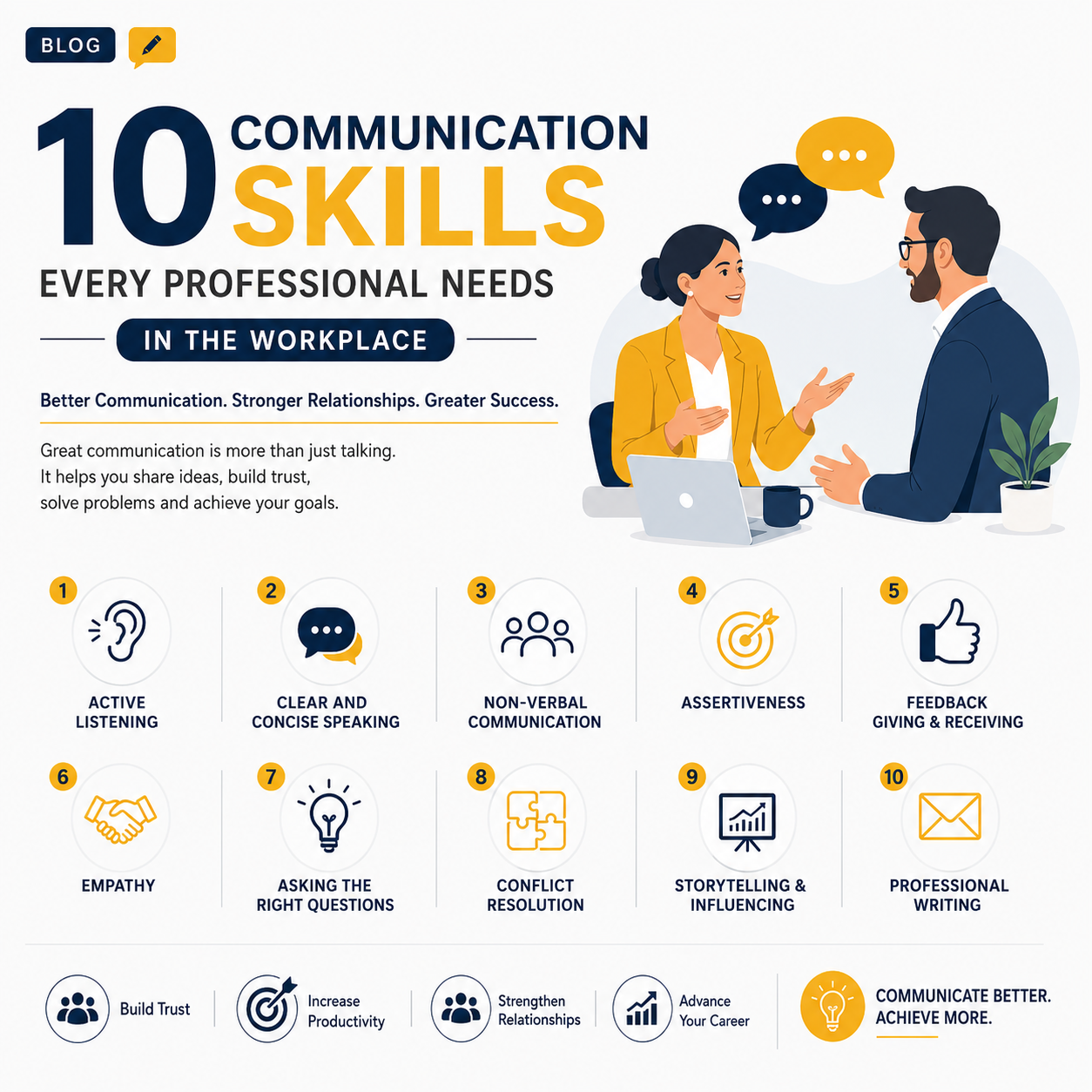
In this guide, we’ll look at 10 essential communication skills every professional should develop and explain how you can use them in everyday workplace situations.
Why Are Communication Skills Important in the Workplace?
Communication affects almost every part of professional life.
Strong communication can help you:
- Express your ideas clearly
- Build stronger professional relationships
- Work better with your team
- Reduce misunderstandings
- Handle workplace conflicts
- Give and receive feedback
- Communicate confidently with clients
- Perform better in meetings and presentations
- Build trust with colleagues and managers
- Create better career opportunities
On the other hand, poor communication can lead to confusion, mistakes, workplace conflicts, missed opportunities, and damaged professional relationships.
You don’t necessarily need to be the most talkative person in the room.
Effective communication is about making sure your message is understood—and understanding the messages of others.
1. Active Listening
Communication isn’t just about speaking.
One of the most valuable workplace communication skills is active listening.
Active listening means giving your full attention to the person speaking instead of simply waiting for your turn to respond.
For example, during a meeting, don’t immediately start thinking about what you’re going to say next. Listen carefully to what the other person is explaining.
How to improve active listening:
- Maintain appropriate eye contact
- Avoid interrupting
- Put away unnecessary distractions
- Ask questions when something isn’t clear
- Repeat or summarize important points
- Pay attention to both words and tone
A simple response such as “So, if I understand correctly…” can prevent many misunderstandings.
Why it matters: People are more likely to trust and respect professionals who genuinely listen to them.
2. Clear and Concise Communication
Have you ever received an email or message that was so complicated that you had to read it several times?
That’s a communication problem.
In the workplace, your goal should be to communicate your message clearly, directly, and efficiently.
Instead of using complicated language, explain your point in a simple way.
For example:
Unclear:
“Regarding the matter we discussed previously, I would like to suggest that perhaps we could potentially consider making some adjustments to the current approach.”
Clear:
“I recommend changing our current approach to improve the results.”
The second version is easier to understand and saves time.
Practice this:
Before speaking or writing, ask yourself:
“What is the main point I want this person to understand?”
Start there.
3. Confidence
Confidence plays a major role in professional communication.
You don’t need to be loud or aggressive to communicate confidently.
Professional confidence means being able to express your thoughts, opinions, questions, and concerns respectfully.
For example:
Instead of saying:
“I’m not sure, but maybe we could try this…”
you could say:
“I recommend trying this approach because it could help us achieve better results.”
The message becomes stronger without becoming disrespectful.
You can build communication confidence by:
- Preparing before important conversations
- Speaking at a steady pace
- Avoiding unnecessary apologies
- Maintaining good posture
- Practicing presentations
- Sharing your ideas during meetings
Confidence grows through practice.
4. Nonverbal Communication
Your words are only one part of communication.
Your facial expressions, posture, gestures, eye contact, and tone of voice can also influence how your message is received.
Imagine someone saying, “I’m happy to help,” while looking annoyed and avoiding eye contact.
You might believe their body language more than their words.
Important nonverbal communication skills include:
- Appropriate eye contact
- Open posture
- Natural facial expressions
- Controlled gestures
- Professional appearance
- Appropriate personal space
- Confident tone of voice
Being aware of your nonverbal communication can make your conversations much more effective.
5. Emotional Intelligence
Workplaces involve people—and people have emotions.
That’s why emotional intelligence is an important communication skill for professionals.
Emotional intelligence helps you recognize and manage your own emotions while understanding the emotions of others.
For example, imagine a colleague reacts negatively to your suggestion.
Instead of immediately becoming defensive, you could ask:
“Is there something about the proposal that concerns you?”
This creates an opportunity for a productive conversation.
Emotional intelligence can help you:
- Stay calm under pressure
- Understand other people’s perspectives
- Respond instead of reacting
- Handle sensitive conversations
- Build stronger relationships
- Manage disagreements professionally
6. Giving and Receiving Feedback
Feedback is essential for professional growth.
However, giving feedback poorly can make people feel attacked or discouraged.
Effective feedback should focus on the behavior, situation, or result—not the person’s character.
Instead of:
“You’re always careless with these reports.”
try:
“There were a few errors in this report. Let’s review them together so we can avoid them next time.”
Receiving feedback is equally important.
When someone gives you constructive feedback, try not to immediately become defensive.
Listen, ask questions, and identify what you can improve.
Professionals who can give and receive feedback effectively are more likely to continue developing.
7. Asking the Right Questions
Good questions can be more powerful than good answers.
Asking questions shows that you’re engaged, interested, and willing to understand the situation before making assumptions.
For example, instead of assuming what a client wants, ask:
- “What result are you hoping to achieve?”
- “What is your biggest priority?”
- “What challenges are you currently facing?”
- “Could you clarify what you mean by that?”
- “What would success look like for you?”
The right questions can uncover information that might otherwise be missed.
Remember:
Don’t be afraid to ask for clarification.
A few seconds spent asking a question can prevent hours of unnecessary work.
8. Adaptability
Not everyone communicates in the same way.
The way you speak with a colleague may be different from how you communicate with a customer, senior manager, or new employee.
Effective professionals learn to adapt their communication based on:
- The audience
- The situation
- The communication channel
- The level of urgency
- The person’s needs
For example, a complex technical explanation may be appropriate when speaking with a specialist but confusing to a customer.
Being adaptable doesn’t mean changing who you are.
It means changing how you communicate so your message can be understood effectively.
9. Conflict Resolution
Disagreements are normal in professional environments.
People have different opinions, priorities, personalities, and working styles.
The important thing isn’t whether conflict happens.
It’s how you handle it.
When dealing with a disagreement:
- Stay calm.
- Listen to the other person’s perspective.
- Avoid personal attacks.
- Focus on the actual problem.
- Ask questions.
- Look for common ground.
- Work toward a practical solution.
Instead of saying:
“This is your fault.”
try:
“Let’s understand what caused the problem and figure out how we can prevent it from happening again.”
This changes the conversation from blame to problem-solving.
10. Professional Written Communication
Emails, messages, reports, proposals, presentations, and other written communication are a major part of modern professional life.
A poorly written message can create confusion or make you appear less professional.
Before sending an important email, check:
Is it clear?
Can the reader understand your main point quickly?
Is it concise?
Have you removed unnecessary information?
Is it professional?
Does your tone match the situation?
Is it accurate?
Have you checked names, dates, numbers, and important details?
Is there a clear action?
Does the recipient know what you need from them?
A simple structure often works well:
Purpose → Important information → Required action → Deadline
This makes professional emails easier to understand and act upon.
How Can You Improve Your Communication Skills?
Knowing these skills is only the beginning.
The real improvement comes from consistent practice.
Here are some practical things you can start doing today.
1. Listen more carefully
During your next conversation, focus entirely on the person speaking.
2. Think before you speak
Take a moment to organize your thoughts before responding.
3. Practice explaining complex ideas simply
If you can explain something complicated in simple language, your communication skills are improving.
4. Ask for feedback
Ask a trusted colleague or mentor:
“What is one thing I could improve about my communication?”
5. Record yourself speaking
Practice a presentation or explanation and listen to the recording. You’ll quickly notice areas where you can improve.
6. Read more
Reading books, articles, and professional material can improve vocabulary, sentence structure, and your ability to express ideas.
7. Practice difficult conversations
Think through challenging workplace situations before they happen.
Preparation can significantly improve your confidence.
Communication Skills vs. Technical Skills: Which Is More Important?
This is not really an either-or question.
Technical skills help you do the job.
Communication skills help you work effectively with people while doing the job.
A highly skilled employee who cannot explain ideas, collaborate with colleagues, communicate with customers, or accept feedback may struggle to reach their full potential.
That’s why employers often look for professionals who combine:
Technical expertise + communication skills + teamwork + professionalism
Developing both sides can make you a much stronger professional.
Final Thoughts
Strong communication isn’t about having the biggest vocabulary or being the most confident speaker.
It’s about understanding people, expressing yourself clearly, listening carefully, and responding appropriately.
The 10 communication skills discussed in this article are:
- Active Listening
- Clear and Concise Communication
- Confidence
- Nonverbal Communication
- Emotional Intelligence
- Giving and Receiving Feedback
- Asking the Right Questions
- Adaptability
- Conflict Resolution
- Professional Written Communication
You don’t have to master all ten at once.
Choose one skill, practice it consistently, and then move to the next.
Over time, better communication can help you build stronger workplace relationships, perform more effectively, handle challenging situations, and create new professional opportunities.
Because in the workplace, knowing what to say is important—but knowing how to communicate it can make all the difference.