

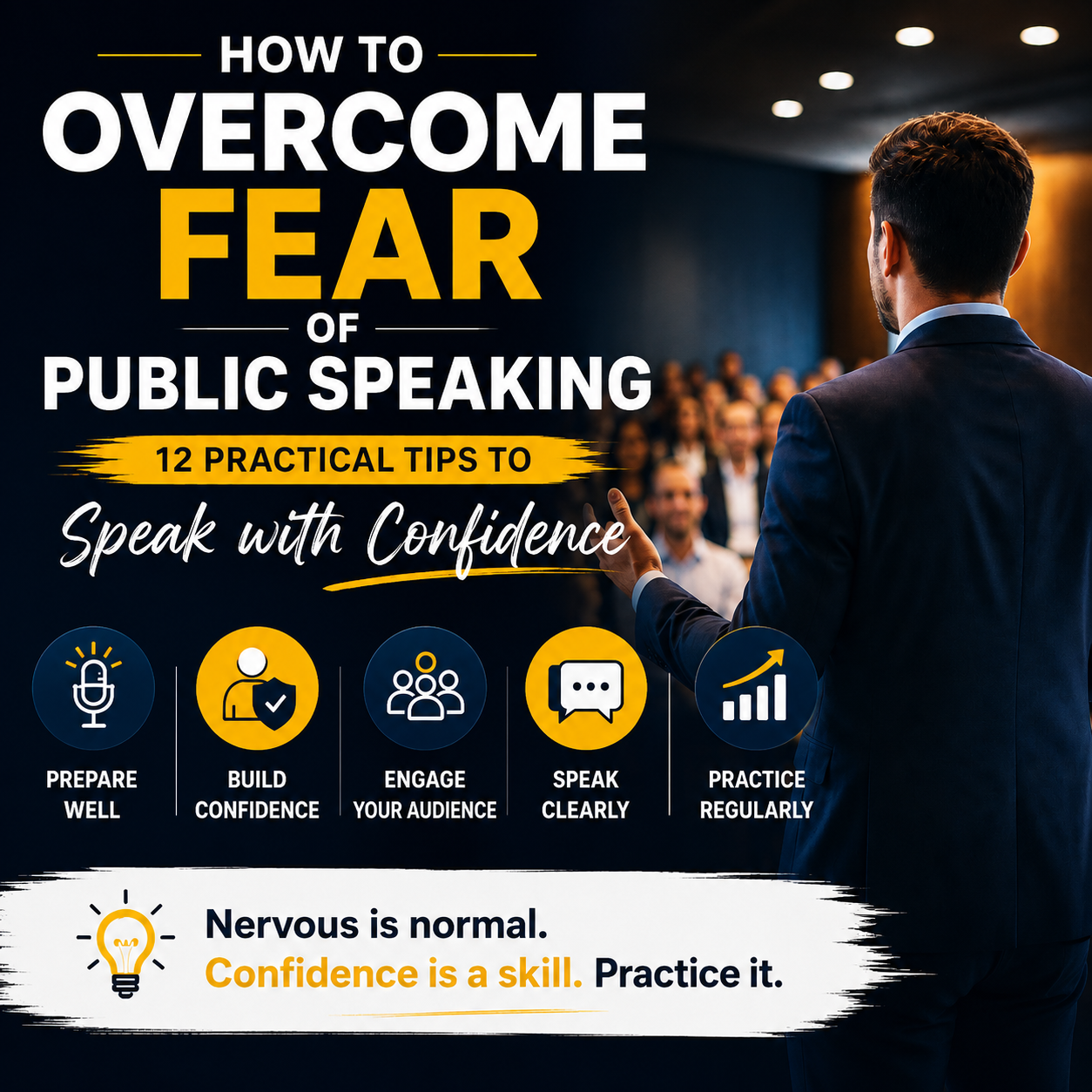
Have you ever been asked to speak in front of a group and suddenly felt your heart beating faster?
Maybe your hands became sweaty. Your voice started shaking. You knew exactly what you wanted to say, but the moment everyone looked at you, your mind went blank.
If that sounds familiar, you’re not alone.
Fear of public speaking is extremely common. It can affect students, employees, managers, business owners and even experienced professionals. Recent 2026 resources continue to describe public-speaking anxiety as a widespread challenge, while training programmes in Muscat specifically address managing nerves, audience engagement and confident presentation delivery.
The good news is that you don’t need to be a naturally confident person to become a confident speaker.
Public speaking is a skill. And skills can be learned.
In this guide, you’ll discover 12 practical ways to overcome fear of public speaking and become more comfortable speaking in meetings, presentations, classrooms, events and professional settings.
What Is Fear of Public Speaking?
Fear of public speaking is the nervousness or anxiety you experience when you have to speak in front of other people.
It can happen when you’re:
- Giving a presentation at work
- Speaking during a meeting
- Introducing yourself to a group
- Giving a speech
- Attending an interview
- Speaking at a conference
- Presenting a business idea
- Answering questions in front of others
- Speaking to senior management
- Addressing a large audience
Some people experience mild nervousness, while others may feel intense anxiety.
Common reactions include:
- Racing heartbeat
- Shaky hands
- Dry mouth
- Sweating
- Fast speaking
- Difficulty concentrating
- Forgetting what you planned to say
- Avoiding eye contact
- Feeling like everyone is judging you
These reactions don’t mean that you’re a poor communicator.
They simply mean that the situation feels high-pressure.
Why Are People Afraid of Public Speaking?
Understanding why you’re nervous is an important first step.
1. Fear of Being Judged
One of the biggest concerns is:
“What will people think about me?”
You may worry about saying something incorrectly, forgetting a point, mispronouncing a word or looking nervous.
The problem is that you can spend so much time thinking about how you appear that you stop focusing on what you’re actually trying to communicate.
2. Fear of Making Mistakes
Many people believe a good speaker should deliver everything perfectly.
That’s unrealistic.
Even experienced speakers pause, forget words, change their sentences or make small mistakes.
A small mistake usually isn’t what the audience remembers.
The message and the way you recover matter far more.
3. Lack of Preparation
Walking into a presentation without knowing your main message can dramatically increase anxiety.
Preparation gives your brain something to rely on.
You don’t necessarily need to memorize an entire speech. In fact, memorizing every sentence can sometimes make things worse because forgetting one sentence can make you panic.
Instead, understand your:
Opening → Main Points → Examples → Conclusion
4. Lack of Practice
Thinking about a presentation isn’t the same as actually delivering it.
You need to practice speaking out loud.
Your brain needs experience turning your thoughts into spoken words.
12 Practical Ways to Overcome Fear of Public Speaking
1. Stop Trying to Eliminate Nervousness Completely
This is one of the biggest mindset changes you can make.
Your goal shouldn’t be:
“I must feel completely calm.”
Instead, think:
“I can feel nervous and still speak well.”
Even experienced speakers can feel nervous before an important presentation.
Confidence doesn’t always mean feeling zero fear.
Confidence means knowing that you can handle the situation even when you’re nervous.
2. Know Your Message Before You Know Your Speech
Don’t begin by memorizing sentences.
Start by asking:
What is the one thing I want my audience to remember?
Then build your presentation around that message.
For example:
Instead of trying to remember 20 different points about workplace communication, your main message could be:
“Clear communication helps teams work faster, avoid misunderstandings and build trust.”
Everything else should support that idea.
This makes your presentation easier to remember and easier for your audience to follow.
3. Practice Out Loud
This sounds simple, but it’s one of the most important public-speaking habits.
Don’t just read your presentation silently.
Stand up and say it.
Practice:
- Your opening
- Your transitions
- Your examples
- Your conclusion
- Your answers to likely questions
You can even record yourself on your phone.
When you watch the recording, look for three things:
Clarity. Pace. Body language.
Don’t criticize everything.
Choose one thing to improve each time.
4. Start With Smaller Speaking Opportunities
If speaking to 100 people terrifies you, don’t make your first goal a 100-person presentation.
Start smaller.
For example:
Step 1: Speak for one minute in front of yourself.
Step 2: Speak to a friend.
Step 3: Speak to two or three colleagues.
Step 4: Participate more actively in meetings.
Step 5: Give a short presentation to a small group.
Step 6: Gradually move toward larger audiences.
Repeated exposure to manageable speaking situations can make the experience feel more familiar over time.
5. Slow Down When You Speak
Nervous speakers often speak too quickly.
You may feel that speaking faster will help you finish sooner.
Usually, it does the opposite.
Fast speech can make you:
- Harder to understand
- More likely to lose your train of thought
- Sound less confident
- Run out of breath
Instead, deliberately slow down.
Use short pauses after important points.
For example:
“There is one thing every successful team needs.”
Pause.
“Clear communication.”
That pause gives your words more impact.
6. Focus on Your Audience, Not Yourself
This is a powerful change in perspective.
Instead of thinking:
“How am I doing?”
Ask:
“How can I help this audience?”
If you’re presenting to employees, your goal might be to teach them something useful.
If you’re presenting a business proposal, your goal might be to help decision-makers understand an opportunity.
If you’re speaking to students, your goal might be to inspire them.
When you focus on serving the audience rather than performing for the audience, the pressure can feel much smaller.
7. Don’t Memorize Every Word
Memorization can create unnecessary pressure.
Imagine you’ve memorized:
“Good morning everyone. Today I am delighted to speak to you about…”
Then you forget the next sentence.
Suddenly, you panic.
Instead, memorize your key ideas, not every sentence.
Use a simple structure:
Opening
What is the problem?
Point 1
What does the audience need to know?
Point 2
What is the solution?
Example
How does it work in real life?
Conclusion
What should the audience do next?
This gives you flexibility.
8. Learn to Use Pauses
A pause doesn’t mean you’ve forgotten what you’re saying.
A pause can make you sound more confident.
Use pauses:
- Before an important point
- After asking a question
- Between major ideas
- Before answering a difficult question
- When you need a moment to think
Instead of:
“So basically what I want to say is that communication is really important because…”
Try:
“Let me make one important point.”
Pause.
“Communication isn’t simply about speaking. It’s about being understood.”
Much stronger.
9. Improve Your Body Language
Your audience doesn’t only listen to your words.
They also notice how you present yourself.
Pay attention to:
Eye contact
Look at different people rather than staring at your slides.
Posture
Stand upright and relaxed.
Hands
Use natural gestures rather than keeping your hands rigid.
Facial expression
Let your expression match your message.
Movement
Move with purpose rather than constantly walking around.
You don’t need theatrical body language.
You simply need to look comfortable enough to communicate naturally.
10. Prepare for Questions
Sometimes the presentation itself isn’t the biggest fear.
It’s the question afterward.
You may think:
“What if someone asks me something I don’t know?”
Prepare for that possibility.
Before your presentation, write down:
5–10 questions people might ask.
Then prepare your answers.
And remember:
You don’t have to know everything.
You can say:
“That’s a good question. I don’t have the exact information with me right now, but I’d be happy to follow up.”
That’s far better than inventing an answer.
11. Learn How to Recover When You Make a Mistake
This is an underrated public-speaking skill.
You will make mistakes.
The goal isn’t to avoid every mistake.
The goal is to recover confidently.
If you forget something:
“Let me go back to that point.”
If you say the wrong word:
“Let me rephrase that.”
If you lose your train of thought:
“The main point I want to highlight here is…”
Then continue.
Your audience is usually much more forgiving than you imagine.
12. Practice Regularly, Not Only Before Presentations
If you only practice public speaking the night before an important presentation, you’ll continue to feel uncomfortable.
Make speaking part of your routine.
Try:
- Speaking during team meetings
- Asking questions
- Explaining an idea to colleagues
- Practicing short presentations
- Recording yourself
- Joining speaking groups
- Taking structured public-speaking training
The objective isn’t to become perfect.
It’s to become more comfortable every time you speak.